

Your marathon goal is realistic if your training already shows it. Three checks tell you: a recent half marathon about 12 to 13 seconds per km faster than goal pace, midweek threshold sessions that feel controlled, and, in the last 10 weeks, long runs with big blocks at goal pace that you finish strong. If those aren’t there yet, the goal is a hope, not a plan.
Most runners pick a marathon goal the other way round. They choose a round number, sub-4, sub-3:30, sub-3, and then train in hope. Race day is a bad place to find out the number was wrong. You find out at 30 km, when the pace that felt easy at 10 km suddenly isn’t.
I have one rule for this: training tells the truth. Not your watch’s race predictor, not one good parkrun, not how motivated you feel in week one.

Why do so many runners pick the wrong marathon goal?
Because the goal is usually chosen before the training starts, and never checked again. Runners tend to overestimate their race-day fitness. One great half marathon becomes the proof that a big marathon goal is on, when the marathon asks for something the half never tested: holding the pace for another 21 km on tired legs.
A post on X this week made the maths clear for a sub-3 marathon. Goal pace is 6:52 per mile. The equivalent half marathon is about 1:26. Threshold, the pace you could hold for about an hour on a perfect day, is around 6:30 per mile. If those numbers aren’t close to what you can run now, the goal needs adjusting or more time. My guide to breaking 4, 3:30 or 3 hours goes deeper on each target.
Runner takeaway: pick the goal from what you’ve done, not from the number you’d like on your medal photo.
What paces does each marathon goal need?
Here are the paces behind the most common goals. The half-marathon column uses my rule of thumb: marathon pace is about 12 to 13 seconds per km slower than half-marathon pace. It’s a guide for a well-trained marathoner, not a guarantee.
| Marathon goal | Goal pace per km | Goal pace per mile | Half marathon you should be close to |
|---|---|---|---|
| 3:00 | 4:16 | 6:52 | about 1:25 to 1:26 |
| 3:30 | 4:59 | 8:01 | about 1:40 to 1:41 |
| 4:00 | 5:41 | 9:09 | about 1:55 to 1:56 |
| 4:30 | 6:24 | 10:18 | about 2:10 to 2:11 |
If your recent half is two or three minutes slower than the column, the goal isn’t impossible, but it’s a stretch for this cycle. If it’s five minutes or more slower, set an honest goal now and save the dream for the next build.
Runner takeaway: your half marathon is the first and simplest reality check.
Check 1: What does your half marathon say?
A half marathon run in decent conditions within the last 8 to 12 weeks is the best single predictor most amateurs have. Use a real race or a hard, honest time trial, not a training run. If you have just run your first half, read what to do after your first half marathon.
Two warnings. First, heat. A half run in hot, humid weather undersells your fitness, and a cool-day marathon pace won’t hold in heat; see my hot weather running tips. Second, timing. A brilliant half four weeks before the marathon can mean you peaked in the wrong place. For intermediates I like a tune-up half earlier in the build; beginners are better with a 10K.
Runner takeaway: use a recent, honest half in good conditions, and adjust for the weather on both days.
Check 2: How do your midweek threshold sessions feel?
Threshold, in plain words, is the pace you could hold for about an hour. Your one quality session a week should live around it: a little slower than threshold early in the build, at threshold later, always faster than marathon pace. See lactate threshold pace and running zones and the one midweek session for how to set it.
An example session: 2 x 20 minutes at threshold effort with 3 minutes of easy jogging between. Another: 5 x 6 minutes slightly faster, 90 seconds easy. On a good day these should feel hard but controlled, about 7 or 8 out of 10. That matches the post on X: the bulk of this work shouldn’t destroy you. More ideas in tempo runs for race pace.
If you can only hit your threshold paces by going to 9 out of 10 and needing three days to recover, your threshold is slower than you think, and your marathon pace should be too. Effort vs pace explains why effort is the better guide on hard days.
Want someone to look at your training and tell you honestly what it says? Your first month of coaching with me is free: claim your free month. Or book a free 20-minute call and bring your last few weeks.
Runner takeaway: threshold sessions should feel controlled. If they’re all-out, your goal pace is too fast.
Check 3: Can you hold goal pace in your long runs?
This is the check that matters most, and the one most runners skip. In my approach, long runs start slower than marathon pace early in the build and move towards it. In the last 10 weeks or so, the long runs carry blocks at goal pace that grow until a large part of the run is at marathon pace.
What to look for:
- Blocks at goal pace that feel steady, not a fight, with heart rate and breathing settled.
- The last block as good as the first. If the pace drifts or form falls apart in the final 20 minutes, the marathon will expose it at 30 km.
- Recovery: you’re ready for normal easy running within two days.
If the long marathon-pace runs keep falling apart, believe them. They’re telling you the truth about race day weeks before it arrives. For goals slower than 4 hours, the longest run should stay around 26 km; you’re judging the quality of the pace blocks, not chasing 35 km. Avoid the traps in long run mistakes and see why marathon legs lock at 25K.
Runner takeaway: the long goal-pace runs are the real test. If they work, the goal is on.
What if your training says the goal is too ambitious?
Adjust it, and feel good about it. A marathon run at the right pace with an even second half is one of the best days you’ll have in running. A marathon run 10 seconds per km too fast for 30 km is one of the worst.
Practical options:
- Move the goal pace 5 to 10 seconds per km slower for this race and run the long blocks there.
- Keep the dream goal, but move it to the next marathon, with a proper base phase first.
- Race smart on the day: first half at the honest pace, then decide at 30 km.
Need to know how much running that takes? See how many km a month you need and how to race your best marathon.
Runner takeaway: an honest goal finished strong beats an ambitious goal walked home.
What if your training says you’re ready for more?
It happens. If your long goal-pace runs feel easy and your threshold sessions keep coming in faster than planned, don’t jump the goal by ten minutes. Adjust the next few weeks from what you actually ran, a few seconds per km at a time, and keep checking. The same rule works in both directions: the training decides.
Runner takeaway: raise the goal slowly, and only on the evidence.
Get the free plans
Building up to your first half? Get my free 12-week Couch to 10K and Half Marathon plans by email:
What my runners say

Anna
“I started with zero running experience. Zero confidence. Zero strength.
With Tassos’ coaching, everything changed. Step by step, smart training, strength work, balance and injury prevention built me up from nothing.
The result? I didn’t just finish one… I completed two consecutive Athens Authentic Marathons — healthy, strong, and smiling at the finish line.
The second marathon? We decided just 3 months before race day — and still nailed it.
No injuries. No burnout. Just smart preparation and belief.”
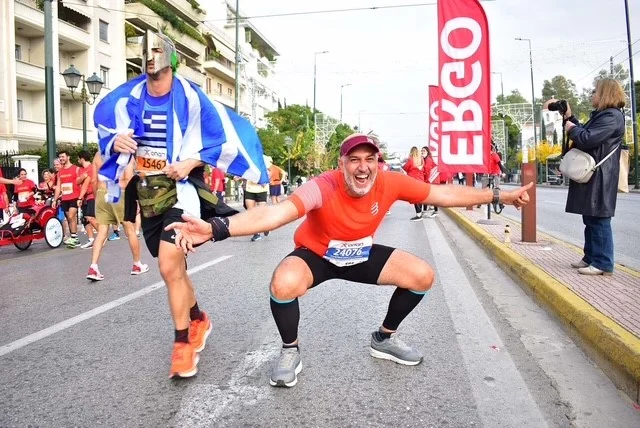
Demetris
“From plateau to breakthrough — exactly what I needed.”
Coach T isn’t just a running coach. He invests time. Real time. Checks in. Adjusts. Cares.
One year ago, I was running without any plan to improve — no progress, just plateau. Through smart, structured training and constant guidance, everything changed.
Step by step, I became stronger, more consistent, and confident — leading to a new Marathon PB at Paris Marathon 2026.
Healthy. Strong. Injury-free.
Train smarter, not harder
Your goal should come from your training, and your training should be built around your life. I’m Coach T, a certified online running coach, and I listen and adjust every week around your work, family and recovery, so it becomes more than a plan. If you’d like an honest read of where you are and what’s realistic, your first month of coaching is free. Prefer to talk first? Book a free 20-minute call.
Keep reading
- How to break 4, 3:30 or 3 hours in the marathon
- The one midweek session that builds marathon fitness
- How to race your best marathon
- Why marathon legs lock at 25K
- How many km a month for your marathon goal
Frequently asked questions
How do I know if my marathon goal is realistic?
Check three things: a recent half marathon about 12 to 13 seconds per km faster than goal pace, controlled midweek threshold sessions, and long runs with big goal-pace blocks that you finish strong.
What half marathon time do I need for a sub-4 marathon?
As a guide, about 1:55 to 1:56 in good conditions, with marathon-specific long runs in your training. Without the long runs, a fast half is not enough.
Are online marathon time predictors accurate?
They are a starting point. Most assume you have done marathon-specific training. Your long goal-pace runs are a better guide than any calculator.
What is threshold pace in simple terms?
The pace you could hold for about an hour in a race on a good day. Most midweek marathon sessions sit just under or at this pace.
Should I change my marathon goal during training?
Yes, if the training says so. Adjust a few seconds per km at a time, based on how your long goal-pace runs actually go.
**Please note that the information shared in this article reflects my personal knowledge and experiences. It is not intended as professional advice and should not be relied upon as such. Always consult with a qualified expert or professional before making any decisions based on the content provided