


A half marathon rewards good training more than almost any other race distance. Run 21.1km off a smart 10-to-12-week plan and you’ll feel strong the whole way round. Run it off random mileage and no speed work, and the last 5km will teach you why pacing matters. Below is a free half marathon training plan you can start using this week, plus the honest signs that tell you when a generic plan has done its job — and it’s time for something built around you specifically.

Who this free plan is for
This plan is built for runners who have already got a 10K in their legs — ideally run within the last few months — and want to step up to 21.1km with a structure, not a guess. It assumes you can currently run 3 to 4 times a week without issue. If you’ve never run continuously for 60 minutes, spend 4 to 6 weeks building a general aerobic base first, then come back to this.
It also assumes you want a finish-strong half marathon, not necessarily a specific time goal. If you’re chasing sub-2:00, sub-1:45 or sub-1:30, the structure below still applies — you’ll just run the key sessions at your own goal pace, which a free, one-size-fits-all plan can only approximate.
The weekly structure
Every week of this plan follows the same simple shape. It’s the same shape used in most well-regarded half marathon programs, because it works:
- 2 to 3 easy runs — conversational pace, these build your aerobic engine without digging a fatigue hole
- 1 speed or tempo session — teaches your body to hold a faster pace under control
- 1 long run — the single most important run of the week, building the endurance that carries you through the back half of the race
- 1 to 2 rest or cross-training days — recovery isn’t optional, it’s where the fitness actually gets absorbed
- Optional: 1 short strength session — 20 minutes of bodyweight work (squats, lunges, glute bridges, planks) measurably reduces injury risk over a training block
Three to four running days a week is enough to safely build to half marathon distance for most first-timers. If you’re already comfortable running 5 days a week, you can add a second easy run rather than a second hard session — more easy mileage is almost always a better trade than more intensity.
The 12-week build, phase by phase
- Weeks 1–4, base building: Easy runs of 25–40 minutes, a long run growing from 8km to 12km, and one light tempo effort (10–15 minutes at a “comfortably hard” pace). Goal: get your body used to the routine before load increases.
- Weeks 5–8, speed development: Introduce one proper interval or tempo session each week (see sample sessions below). Long run grows from 13km to 17km, with the final 2–3km of one long run each fortnight run at or near goal race pace.
- Weeks 9–10, peak training: Your biggest week. Long run hits 18–19km, speed session stays sharp but doesn’t get longer, total weekly volume peaks here.
- Weeks 11–12, taper: Volume drops by roughly 30% in week 11 and 50% in race week, while intensity stays — short, sharp efforts at race pace keep the legs switched on without digging more fatigue.
Each “down week” (roughly every fourth week) should cut volume by about 20–25% rather than adding more. This is what lets the previous three weeks of work actually turn into fitness instead of accumulated fatigue.
Three sample speed sessions
You only need one of these per week. Rotate between them through the plan so your legs adapt to a few different stimuli rather than the same single workout on repeat.
- Progression run: 8–10km total — first third easy, middle third at half marathon goal pace, final third at 10K pace, then an easy cool-down. Teaches you to run strong when your legs are already tired, which is exactly what happens in the last 5km of race day.
- Tempo intervals: After a 10-minute warm-up, run 3 x 8 minutes at half marathon goal pace with a 2-minute easy jog between each rep, then a 10-minute cool-down. This is the single best workout for teaching your body what “race effort” should actually feel like.
- Mixed-pace intervals: After warming up, 4 x 1km at 10K pace with 90 seconds jog recovery, followed by 4 x 400m at 5K pace with 2 minutes recovery. Sharpens leg turnover and makes goal pace feel easier by comparison.
If any of this feels unfamiliar, a local running club session once a week is a great low-cost way to learn proper pacing with company — you don’t need a track, just somewhere flat, quiet and reasonably traffic-free.
Long runs: the part that actually wins you the race
Your long run should be run 60–90 seconds per kilometre slower than goal half marathon pace — easy enough to hold a conversation for most of it. Two things turn a decent long run into a great one:
- Practice race-day fuelling. If your half marathon will take over 75–90 minutes, start taking a gel or carb source every 35–45 minutes during your longer runs now, not for the first time on race morning.
- Practice everything else, too. Same shoes, same breakfast timing, same morning routine. Where possible, run at the same time of day your race starts — your body genuinely performs differently at 7am versus midday, and you want no surprises.
In the second half of the plan, add short blocks of goal pace into the long run — for example 2–3km at race pace, back to easy, repeat. It teaches your legs to shift gears while already carrying fatigue, which is the exact skill a half marathon demands late in the race.
Race week and pacing on the day
Two pacing strategies work well for a half marathon. Most runners do best starting at goal pace and holding nice even splits, with a small push in the final kilometre once the finish is in sight. If you’re newer to racing or tend to get overexcited on the start line, starting 10–15 seconds per kilometre slower than goal pace and gradually working up to it is the safer option — it trades a small amount of time for a much lower risk of blowing up at 16km.
Either way, know the course before race day. Check the elevation profile, note where any hills sit, and if it’s a local race, drive or run parts of the route beforehand. A flat, well-known course is far easier to pace evenly than one you’re discovering for the first time at race pace. The same taper logic scales up, too — here’s what to do in the last 7 days before a marathon.
Common mistakes that derail a half marathon build
Most half marathon training plans don’t fail because the plan was wrong — they fail because of a handful of avoidable habits. Watch out for these:
- Running every easy run too fast. If your “easy” pace creeps toward tempo pace, you never fully recover, and your actual speed session on hard days suffers because your legs are already tired. Easy should feel genuinely easy.
- Skipping the down weeks. It’s tempting to keep pushing volume every single week. The recovery weeks are not wasted training — they’re when the previous three weeks of stress actually turns into fitness.
- Chasing the long run distance instead of the long run purpose. A 17km long run run too fast teaches your body the wrong lesson. Slow down, especially in the first two-thirds.
- Trying something new on race day. New shoes, new gels, a new breakfast — save the experiments for training runs, not the start line.
- Ignoring niggles. A tight calf or sore knee that gets worse over a run, not better, is your body asking for an easier few days. Pushing through it is how a manageable niggle becomes a six-week injury.
Gear worth getting right
You don’t need much to train for a half marathon, but two things are worth getting right. First, shoes: get properly fitted at a specialist running shop rather than guessing, and rotate between two pairs through the training block if you can — it reduces repetitive strain on any one part of your foot and lower leg. Second, whatever you plan to race in, do at least two or three long runs in those exact shoes beforehand. Race day is the wrong time to discover a shoe that looked great in the shop rubs after 15km.
Signs you’ve outgrown the free plan
A generic plan like this one is genuinely good for a first half marathon or a “just get round strong” goal. It stops being enough once any of these start showing up:
- You’ve plateaued — your easy pace, long run distance, or race times haven’t moved in two or three training cycles
- You’re chasing a specific time goal and need sessions built around your actual current fitness, not a generic pace band
- Niggles keep showing up, and you suspect the plan isn’t adjusting to how your body is actually recovering week to week
- Life keeps getting in the way — travel, work, family — and a fixed PDF plan can’t move with you, but a coach can
- You want someone checking your training weekly and adjusting it, instead of hoping a static plan happens to fit
None of that means the free plan failed you. It means it did exactly what a free, general plan is supposed to do — and now the returns on a personalized one are bigger than the returns on repeating the same structure again.
Hit a plateau, or want a plan built around your own fitness and goal time? Coach Tazi will build you a personalised 4-week plan — free, no obligation.
Free plan vs. 1-on-1 coaching
- Free plan: Fixed structure, same for every runner, no adjustments once it’s written, no feedback loop.
- 1-on-1 coaching with Coach Tazi: A personalized plan built around your current fitness, schedule and race goal, with weekly adjustments based on how you’re actually recovering, direct messaging access to the coach, and race-specific pacing, fuelling and taper guidance. Coaching runs €79/month or €599/year, can be paused any time for injury or travel with no lost time, and currently starts with a free first month — no card required.
What Runners Are Saying

Anna
“I started with zero running experience. Zero confidence. Zero strength.
With Tassos’ coaching, everything changed. Step by step, smart training, strength work, balance and injury prevention built me up from nothing.
The result? I didn’t just finish one… I completed two consecutive Athens Authentic Marathons — healthy, strong, and smiling at the finish line.
The second marathon? We decided just 3 months before race day — and still nailed it.
No injuries. No burnout. Just smart preparation and belief.”
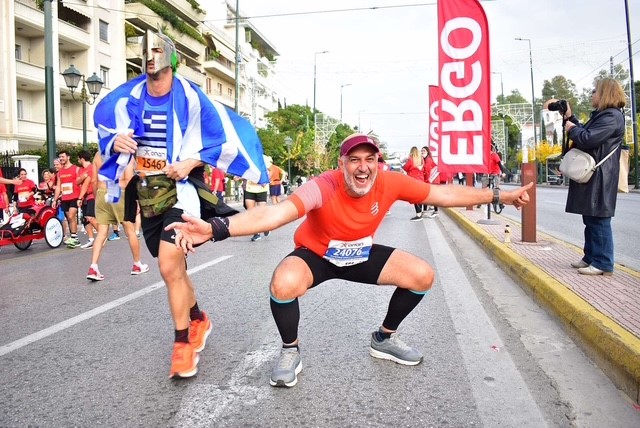
Demetris
“From plateau to breakthrough — exactly what I needed.”
Coach T isn’t just a running coach. He invests time. Real time. Checks in. Adjusts. Cares.
One year ago, I was completely stuck — no progress, just plateau. Through smart, structured training and constant guidance, everything changed.
Step by step, I became stronger, more consistent, and confident — leading to a new Marathon PB at Paris Marathon 2026.
Healthy. Strong. Injury-free.
Frequently asked questions
Is 12 weeks enough to train for a half marathon? Yes, for most runners who already have a base of 3–4 runs a week and a recent 10K behind them. If you’re starting from less than that, add 4–6 weeks of easy base building first.
How many days a week should I run? 3 to 4 is enough to finish strong. 5 is fine if your body is used to it, but add the extra day as easy mileage, not another hard session.
Do I need speed work, or just a long run? Both. The long run builds endurance; the weekly speed session teaches your legs to hold goal pace under control, so the last 5km doesn’t fall apart.
What if I miss a week of training? One missed week changes very little — just resume the plan where you are rather than trying to cram it back in. This is exactly the kind of situation where a coach who can actually re-shuffle your plan earns their keep.
When should I move from a free plan to a coach? As soon as you have a specific time goal, you’ve plateaued, or you want someone adjusting your training around your real life instead of a fixed PDF.
How to get started
Use the structure above as your free half marathon training plan and get started this week — it’s a genuinely solid foundation. If you want it built around your actual fitness, schedule and goal time, or you’ve hit the point where a fixed plan isn’t moving the needle anymore, grab your free first month of 1-on-1 coaching with Coach Tazi — no card required. You can also see what’s included in ongoing coaching, learn more about Coach Tazi’s background and approach, or read about marathon coaching if the half marathon is just your stepping stone to 42.2km.
Ready to stop guessing? Fill in the short form and Coach Tazi will personally contact you to build your plan.
**Please note that the information shared in this article reflects my personal knowledge and experiences. It is not intended as professional advice and should not be relied upon as such. Always consult with a qualified expert or professional before making any decisions based on the content provided