

Knowing how to race your best marathon matters as much as the training behind it. Most runners lose time not because they lacked fitness, but because of a handful of avoidable mistakes on race weekend: untested kit, an over-excited start, too little fuel, and a mind that gives up at the first bad patch. This guide covers the whole race: rehearsing race day, the final week, race morning, pacing, fuelling and the mental side, from a coach who has run more than 20 marathons.
Your training is done. Now comes the part most runners get wrong.
You have put in the miles. The early alarms, the long runs in the heat, the interval sessions that left you bent over your knees. You have earned your place on the start line.
And yet, every year, I watch strong, well-trained runners throw it all away in a single morning. Not because they lacked fitness, but because they made a handful of avoidable mistakes on race weekend.
I know this from the inside. I have run more than 20 marathons, from Riga to Barcelona to Thessaloniki, and I am still chasing my own sub-3. I have had races where everything clicked and races where my body locked up at 25 km with half the course still ahead (I explain why that happens in why your legs lock at 25K). Every one of them taught me something. This article is everything I wish someone had told me before my first marathon, and everything I now build into the plans I write for the runners I coach.
Read it, save it, and come back to it the week before your race. If you are still building your training, start with the marathon training plan guide first.
1. Race day should feel like a dress rehearsal you have done ten times
The perfect marathon is built weeks before the gun goes off. Your goal is simple: nothing on race morning should be a surprise.
That means your shoes, socks, shorts, breakfast, gels and drinks have all been tested on long runs. Not on an easy jog, but on runs with real blocks at goal marathon pace. A classic session I use with my athletes is a long run that alternates easy kilometres with marathon-pace kilometres, or a progression like 3 km easy, 20 to 26 km at marathon pace, 3 km easy. That is where your body learns what goal pace feels like, and where your stomach learns to accept a gel at that speed.
Your race shoes need at least 30 to 50 km in them before the big day. Enough to know there are no hot spots, but fresh enough to still have their pop.
The expo trap
Here is the mistake I see most often among experienced runners, and I have been tempted by it myself. You arrive at the race expo, surrounded by shiny new supershoes, new gels and new gadgets. Everyone is talking about the latest thing. Suddenly you convince yourself that the setup you trained with for four months is not good enough.
Walk away. A blister at 30 km or a gel your gut has never met will cost you far more than any new product could give you.
Coach T tip: Write a race-day checklist a week out. Bib, safety pins, timing chip, shoes, kit, gels plus two spares, a spare pair of socks, anti-chafe balm, and your bag-drop clothes. Fewer decisions on race morning means more energy for the race.
Not sure your long runs are race-specific enough? My plans build marathon-pace blocks into your long runs from week one. Book a free 20-minute call and I will show you exactly where your training needs to go.
2. The final week: you can’t gain fitness, but you can lose a race
In the last seven days, no workout will make you fitter. But poor food choices, bad sleep or one session too many can absolutely make you slower. For the day-by-day version, read what to do 7 days before a marathon.
Carb-load like you mean it, with familiar food
Your muscles and liver store carbohydrate as glycogen, roughly 400 to 600 grams in a well-fuelled runner. That is your premium race fuel. Most runners dramatically underestimate how much carbohydrate a proper load requires. Over the final 36 to 48 hours, research-backed targets sit around 8 to 12 grams of carbohydrate per kilogram of body weight per day. For a 70 kg runner, that can be 600 to 800 grams a day.
That is a lot of food, and that is exactly why you should practise it before a long run in training first. A few rules that work for my athletes:
- Spread it across the day. Several medium meals and snacks beat two enormous dinners.
- Keep it simple and familiar. Rice, pasta, bread, potatoes, bagels, rice cakes, juice.
- Reduce fibre and fat in the final 24 hours so your gut stays calm.
- Carbohydrate drinks are a useful top-up, not a replacement for real food.
- If you are travelling abroad, plan where you will eat. A new restaurant the night before is a gamble.
The opposite mistake is just as common. Cramming in pizzas and heavy meals you never normally eat leaves you feeling bloated and sluggish on the start line. Carb-loading is about the right fuel, not just more calories.
Sleep: bank it early
Most runners sleep badly the night before a marathon. Nerves, an early alarm, a strange hotel bed. That is normal, and plenty of people run personal bests on four hours of sleep. What matters more is the sleep you bank on the four or five nights before. That part you can control.
Keep the legs ticking over
There is no single right answer to how much to run in race week. Many of my athletes do a short sharpener midweek, such as 4 to 5 x 1 km at goal marathon pace, and then easy 20 to 30 minute jogs or full rest. Keep intensity low, keep it short, and only run if it makes you feel better.
3. Race morning: remove every unknown
Big city marathons can be chaotic. Thousands of runners, long toilet queues, bag drops, closed roads. Stress burns energy you need for the race.
Do your homework in the days before:
- Know where the start is and exactly how you will get there.
- Check bag-drop rules and your wave or corral start time.
- Study the course map, the elevation, and where the water and gel stations are.
- Eat your tested breakfast about 3 hours before the start. Something like bagels or white bread with jam and a little peanut butter, plus a carb drink, works for many runners.
- Arrive 60 to 90 minutes early. Enough time for the toilet, a short warm-up, a final top-up of carbs, and the toilet again.
Nerves are a sign you care
Feeling nervous before a marathon is completely normal, especially with a time goal. The best cure is preparation: every worry you can answer in advance is one less on the start line. Worried about fuelling? Practise it. Worried about the course? Study it.
And remember: you do not owe anyone your goal time. Some runners thrive on announcing it. Others run their best when they quietly keep it to themselves. One race result does not define you as a runner. Most of us need several marathons to find our true potential.
Check the weather and set A, B and C goals
Weather is the one thing you cannot control, and I take it seriously. Some of my own toughest marathons were run in warm conditions that made goal pace feel very different. Watch the forecast in race week and use a weather-adjusted pace calculator, such as the running pace calculator, if it looks hot or windy.
Then set three goals:
- A goal: the time you trained for, if everything goes right.
- B goal: a strong, realistic result if conditions or your body are not perfect.
- C goal: run a smart, controlled race and finish proud, whatever the clock says.
A hot day does not waste your training block. You can still run a brilliant race relative to the conditions and the runners around you.
4. Pacing: hold back so you can fly home
If you remember only one thing from this article, make it this: the first 10 km should feel almost too easy.
You are tapered, rested, full of carbohydrate and adrenaline, and surrounded by a cheering crowd. That freshness tricks you into believing you are fitter than you are. If you trained for 5:00/km, running 4:40/km early feels wonderful. The bill arrives at 30 km, and it is expensive.
A few pacing rules I give every athlete:
- Do not weave. Zig-zagging through a packed start to win back 20 seconds wastes energy and adds distance. Settle in. Those seconds will come back naturally.
- Do not chase lost time. If the first kilometre is slow because of congestion, let it go.
- Know your GPS reads long. Tall buildings and tunnels confuse watches, and you will rarely run the perfect racing line. Aim to run 2 to 4 seconds per kilometre faster on your watch than your goal pace, and use the official kilometre markers as your truth.
- Use auto-lap. Lap pace every kilometre lets you tick the race off one piece at a time.
The reward for patience is one of the best feelings in sport. When you run an even or negative split, the second half of a marathon turns into a hunt. You pass runner after runner who went out too hard. Every runner you pass gives you more energy. That feeling is what I want for every athlete I coach. To set realistic goal paces, try the pace percentage calculator.
Want a pacing strategy built for your exact goal and your race course? Coaching includes a personal race-day pacing and fuelling plan. Get your free first month of coaching and start training at the right paces today.
5. Fuelling: the science of the wall, and how to avoid it
The “wall” is not a myth and it is not a lack of willpower. It usually strikes between 30 and 35 km, and it is mostly a fuel problem.
Here is the simple version. At marathon effort, your body burns a mix of fat and carbohydrate. Fat is plentiful but slow. Carbohydrate is fast but limited. About four-fifths of your stored glycogen sits in your muscles and the rest in your liver. Each gram gives about 4 calories, so 500 grams of glycogen is roughly 2,000 calories. A marathon can cost 2,500 to 3,500 calories depending on your size and speed. Run faster than your fitness allows, skip the carb-load, or skip the gels, and the tank empties before the finish.
When it does, the drop is dramatic. Pace can fall by 10 to 15 percent or more, your legs feel like concrete, and some runners even become confused or dizzy as blood sugar falls. That is why you cannot simply “think” your way through a true wall. The fuel is gone.
The good news? It is almost entirely preventable.
- Start fuelling early. Take your first gel around 30 to 40 minutes in, then every 30 to 45 minutes. Waiting until you feel tired is too late.
- Aim for 60 to 90 grams of carbohydrate per hour. Your gut absorbs around 60 g/h of glucose. Gels that combine glucose and fructose use two different transport routes, so you can absorb more without a stomach revolt.
- Train your gut. Practise taking gels at goal pace on long runs, not only on easy jogs. Your stomach adapts just like your legs.
- Even the taste helps. Carbohydrate in your mouth signals to your brain that fuel is coming, which can lower your sense of effort.
- Plan around the course. Know where water stations are and take gels just before them. Decide in advance if you will carry everything yourself.
For exact numbers by finish time, see marathon fuelling by pace.
6. Bad patches are not the wall: how to win the mental battle
Even in a perfectly fuelled, perfectly paced marathon, it will get hard. Usually more than once. That is not failure. That is the marathon.
The key is knowing the difference. The true wall is a fuel crisis that arrives and stays. A bad patch is general fatigue that comes and goes. You see one slow kilometre on your watch, your mind starts calculating a disaster finish time, and the doubt feeds itself. Then, a few kilometres later, you are back on pace. Most of what runners call “the wall” is actually a bad patch they could have worked through.
Here are the tools I teach my athletes for those moments (more in mental prep to avoid hitting the wall):
- Expect it. When the hard moment arrives, greet it: “There you are. I planned for you.” It loses half its power.
- Chunk the distance. Never think “12 km to go”. Think “two parkruns and a bit”, or “my usual Sunday loop”. Make the remaining distance familiar.
- Have a focus anchor. Count your steps to 100, repeat a mantra, focus on the next kilometre marker or the next gel. Give your mind a job so it cannot spiral.
- Smile and use the crowd. It sounds silly, but a genuine smile and a high-five can lift your pace within a minute.
- Keep fuelling. Low blood sugar makes your thinking darker. Take the gel on schedule even when you do not feel like it.
- Remember your why. Why did you start this journey? Who are you running for? Bring that picture into your head at 35 km.
One honest note: grit is powerful, but it is not everything. If you feel dizzy, confused, have chest pain, or something feels truly wrong, stop and get help. No finish time is worth your health.
The three things to take away
- Prepare everything in advance. Kit, shoes, breakfast, fuel and logistics. Fewer unknowns, better race.
- Start slower than your excitement wants. Trust your training and save your energy for the final 10 km.
- Stay patient when it gets hard. It is supposed to. Fuel, focus, and remember your why.
Want a race plan built around your goal?
This guide gives you the principles. It cannot know your pace, your course, your history or how your week really looks. Your best marathon comes from a plan built around you, with a coach who adjusts it as your training goes. Coach Tazi is more than the person who writes your plan: he listens, and he adjusts your training around your work, family and life.
Training for a marathon? Tell Coach Tazi your goal and race date, and he will personally get back to you.
Not ready for a marathon yet? Start here
If a marathon is still a few months away, the free 12-week plans are a good place to start. Enter your email and Coach Tazi will send the Couch to 10K and half marathon plans straight to your inbox.
Free plan vs. 1-on-1 coaching
- Free plans and guides: a fixed structure that is the same for every runner, with no feedback and no adjustments once you start.
- 1-on-1 coaching with Coach Tazi: a plan built around your fitness, pace and race date, with weekly adjustments, direct messaging, and race-day pacing and taper guidance. Coaching runs €79 a month or €599 a year (less than €50 a month), can be paused for injury or travel, and starts with a free first month. See the coaching packages, or read how much an online running coach costs.
What Runners Are Saying

Anna
“I started with zero running experience. Zero confidence. Zero strength.
With Tassos’ coaching, everything changed. Step by step, smart training, strength work, balance and injury prevention built me up from nothing.
The result? I didn’t just finish one… I completed two consecutive Athens Authentic Marathons — healthy, strong, and smiling at the finish line.
The second marathon? We decided just 3 months before race day — and still nailed it.
No injuries. No burnout. Just smart preparation and belief.”
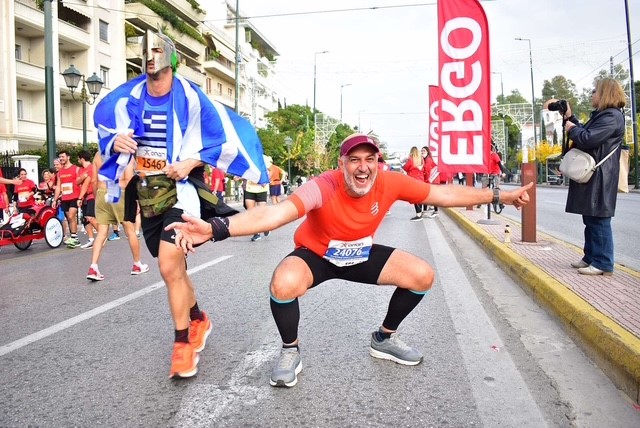
Demetris
“From plateau to breakthrough — exactly what I needed.”
Coach T isn’t just a running coach. He invests time. Real time. Checks in. Adjusts. Cares.
One year ago, I was completely stuck — no progress, just plateau. Through smart, structured training and constant guidance, everything changed.
Step by step, I became stronger, more consistent, and confident — leading to a new Marathon PB at Paris Marathon 2026.
Healthy. Strong. Injury-free.
Frequently asked questions
How should I pace the first 10 km of a marathon? It should feel almost too easy. You are rested and full of adrenaline, so going out fast feels wonderful and costs you at 30 km. Settle into goal pace, do not weave through the crowd, and do not try to win back time lost to congestion.
When should I take my first gel in a marathon? Take your first gel around 30 to 40 minutes in, then every 30 to 45 minutes, aiming for 60 to 90 grams of carbohydrate per hour. Practise this on your long runs at goal pace so your stomach is used to it.
How much carbohydrate should I eat before a marathon? For the final 36 to 48 hours, research-backed targets are around 8 to 12 grams of carbohydrate per kilogram of body weight per day, using familiar foods spread across several meals and snacks, with less fibre and fat in the final 24 hours.
What is the difference between the wall and a bad patch? The true wall is a fuel crisis that arrives, usually between 30 and 35 km, and stays. A bad patch is general fatigue that comes and goes. Most runners who think they hit the wall actually had a bad patch that fuelling, chunking the distance and patience could have carried them through.
How much should I run in marathon week? Keep it short and easy. Many runners do a brief sharpener midweek, such as 4 to 5 x 1 km at goal marathon pace, then easy 20 to 30 minute jogs or full rest. No workout in the final week will make you fitter, so only run if it makes you feel better.
How to get started
Use the structure above to plan your race, and set your paces with the running pace calculator. When you are ready for a plan built around you, book a free call with Coach Tazi, or learn more about your coach. You can also browse all of our training articles.
See you on the start line.
Coach T Running Fitness 365
Ready to stop guessing? Book a free call and Coach Tazi will help you build your race plan.
**Please note that the information shared in this article reflects my personal knowledge and experiences. It is not intended as professional advice and should not be relied upon as such. Always consult with a qualified expert or professional before making any decisions based on the content provided