


In the world of middle- and long-distance running, most workouts focus on aerobic capacity, lactate threshold, or race-specific endurance. But sometimes, to make a leap in performance—or to break through a frustrating plateau—runners need a different kind of stimulus. One that develops raw power, optimizes running mechanics, and sharpens neuromuscular coordination.
Enter the hill sprint: a short, explosive uphill run, lasting just 8–10 seconds, designed to improve running economy, stride power, and neuromuscular precision. But to truly benefit from them, you must understand how to do hill sprints correctly. That’s where hill sprint technique comes into play.


“From plateau to breakthrough — exactly what I needed.”
Coach T isn’t just a running coach.
He invests time. Real time.
Checks in. Adjusts. Cares.
One year ago, I was completely stuck — no progress, just plateau.
Through smart, structured training and constant guidance,
everything changed.
Step by step, I became stronger, more consistent, and confident —
leading to a new Marathon PB at Paris Marathon 2026.
Healthy. Strong. Injury-free.
— Demetris
What Are Hill Sprints (Hill Blasts)?
Hill sprints, sometimes called hill blasts, are short bursts of sprinting—lasting just 8 to 10 seconds—done on a moderately steep hill (around 5% grade). They’re performed at around 98% effort, followed by a 2-minute and 30-second walk recovery.
The purpose isn’t to build endurance—it’s to improve explosive strength, fast-twitch muscle recruitment, and running form without inducing fatigue. When programmed and executed using proper hill sprint technique, they become a powerful tool for runners across all distances.
The Science Behind Hill Sprints
1. Phosphagen System (ATP-PC)
Hill sprints rely on the ATP-PC system, also called the phosphagen system, which fuels high-power movements lasting less than 12 seconds.
- The body uses ATP (adenosine triphosphate) for immediate energy.
- After 2–3 seconds, phosphocreatine is used to regenerate ATP.
- The energy available is very limited and depleted quickly.
- It takes 2–3 minutes to fully replenish—hence the long recovery.
By limiting hill sprints to 8 seconds, runners stay within this system, avoiding lactate buildup and fatigue while maximizing power and form.
🏃♂️ Talk to Coach T Today -1 Month Free Training2. Neuromuscular Efficiency
High-quality sprinting—especially when done with good hill sprint posture—sharpens:
- Motor unit recruitment and coordination
- Fast-twitch fiber activation
- Ground contact mechanics
- Running economy
When runners use proper hill sprint form, these short efforts reinforce biomechanical efficiency without disrupting overall training load.
Why Hill Sprints Help Break Plateaus
Many distance runners train primarily in aerobic zones, which can neglect neuromuscular strength and stride mechanics. Over time, this leads to stagnation.
Hill sprints provide a potent stimulus by:
- Engaging underused fast-twitch fibers
- Improving stride force and elasticity
- Enhancing coordination and posture under load
- Resetting poor movement patterns
They’re particularly effective when runners have hit a plateau or are trying to improve running economy in the early phases of a training cycle.
Mastering Proper Hill Sprint Form: The 4 Key Cues
Executing the correct hill sprint technique is what unlocks all these benefits. Without good form, you risk injury and miss the neural and biomechanical advantages.
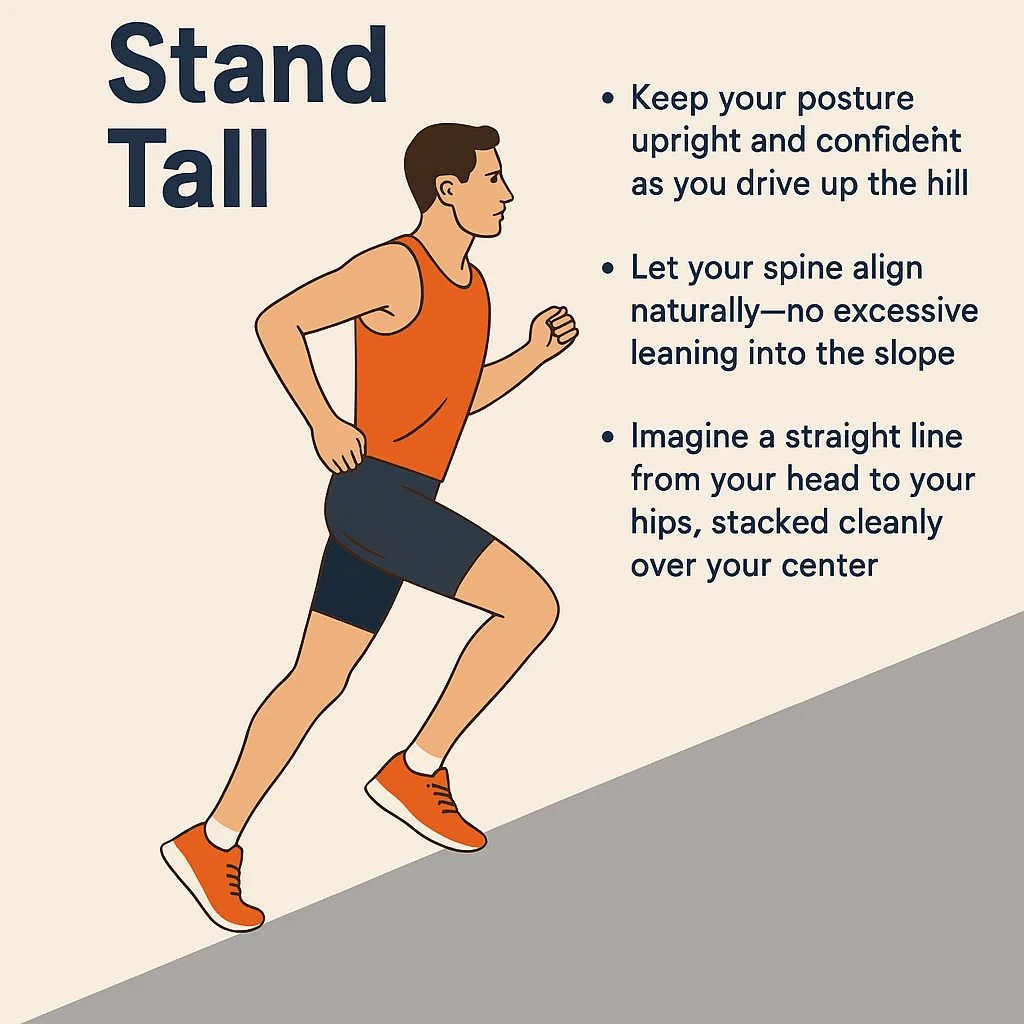
1. “Stand Tall & Proud”
Focus on maintaining a strong, upright posture throughout the sprint.
- Keep your torso perpendicular to the hill—don’t lean forward excessively.
- Stack your hips beneath your shoulders.
- Imagine a straight line running from head to heel.
✅ Hill sprint posture tip: Don’t collapse at the hips—staying tall keeps your stride efficient and powerful.
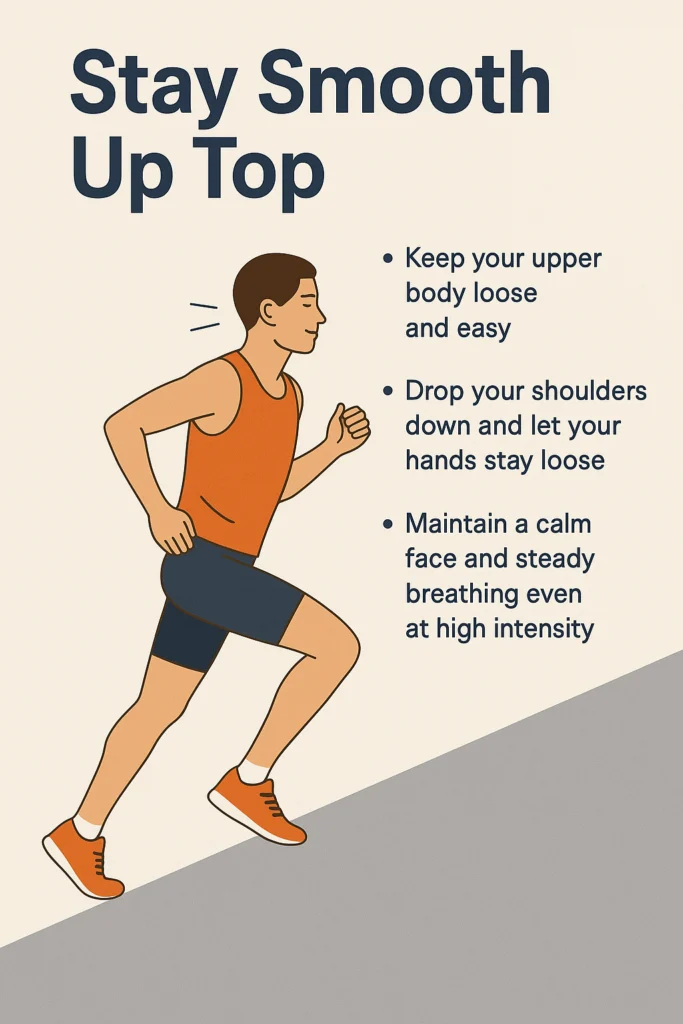
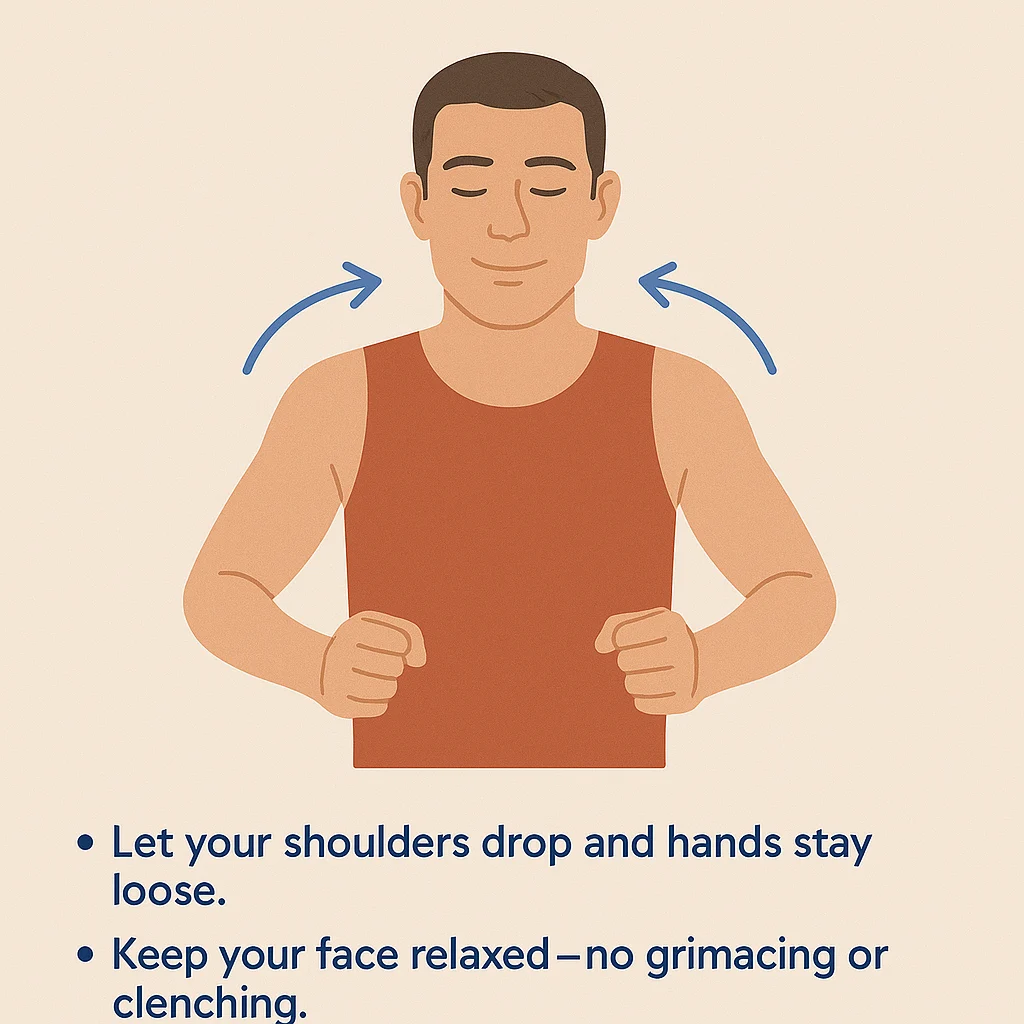
2. “Stay Smooth Up Top”
Relaxation prevents wasted energy and improves arm swing efficiency.
- Let your shoulders drop and hands stay loose.
- Keep your face relaxed—no grimacing or clenching.
- Breathe rhythmically even during sprints.
✅ This part of hill sprint technique is often overlooked, but tension in the upper body can ruin stride efficiency.
3. “Drive Like Pistons”
Efficient arm mechanics drive the legs and stabilize the torso.
- Elbows should pump straight back, not across your body.
- Think vertical—not wide or sideways swinging.
- Your arms act like pistons, directing energy forward.
✅ This helps maintain balance and rhythm, especially when you’re learning how to do hill sprints correctly.
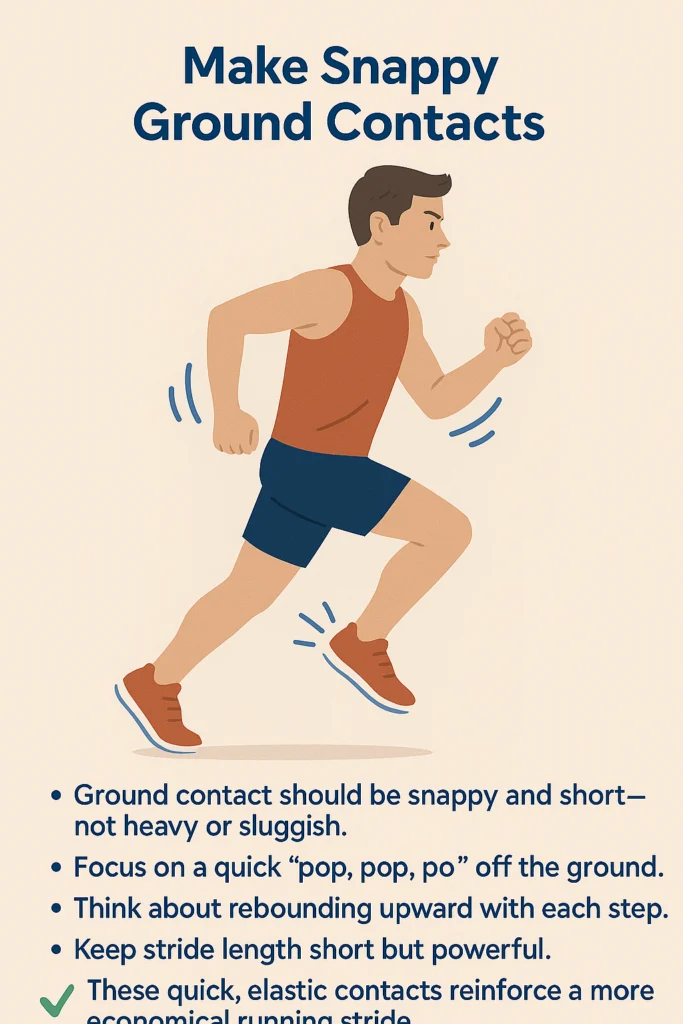
4. “Bounce with Rhythm”
Ground contact should be snappy and short—not heavy or sluggish.
- Focus on a quick “pop, pop, pop” off the ground.
- Think about rebounding upward with each step.
- Keep stride length short but powerful.
✅ These quick, elastic contacts reinforce a more economical running stride.
Weekly Progression: Building Smartly
Since hill sprints are intense, progression should be gradual. Here’s a 3-week entry-level block:
- Week 1: 4 x 8-second hill sprints (2:30 recovery)
- Week 2: 5 x 8-second hill sprints (2:30 recovery)
- Week 3: 6 x 8-second hill sprints (2:30 recovery)
After 3 weeks, experienced runners may build to 8–10 reps per session. Don’t exceed 10 seconds per sprint and do not exceed the 8 repetitions—stick to the ATP-PC window to keep the sprint clean and powerful.
Where to Place Hill Sprints in a Training Week
You can use hill sprints:
- After an easy run to add neural stimulus
- Replace an easy run of your week
- In base training to build economy and power
- Use them once a week at most.
Sample Hill Sprint Workout
Here’s how to structure a full session that emphasizes hill sprint technique:
🔥 Hill Sprint Technique Session
Warm-Up (20 min)
- Easy jog + dynamic mobility drills
- 2 x strides on flat ground
Main Set
- 5 x 8-second hill sprints @ 98% effort
- Walk down for 2:30 recovery each time
- Focus on: “Tall, Smooth, Piston, Pop”
Cooldown
- 10–15 min easy jog
- Light stretching and mobility
✅ Don’t rush the recovery—form and power matter more than total volume.
Common Mistakes to Avoid
To make the most of hill sprints, watch out for these form killers:
- Leaning too far forward → breaks alignment and limits power
- Arms swinging across the body → wastes energy, reduces balance
- Running too long (over 10s) → engages anaerobic glycolysis, causes fatigue
- Inadequate recovery → form breaks down, defeats purpose
- Grimacing or tensing up → upper body should stay calm and smooth

Hill Sprint Technique Unlocks Power and Precision
Hill sprints are short, simple, and deceptively powerful. When used correctly—with a focus on proper hill sprint form—they can improve running economy, neuromuscular coordination, and sprinting mechanics without adding fatigue.
Whether you’re a marathoner looking to sharpen mechanics or a track athlete wanting to boost power output, mastering hill sprint technique is a low-risk, high-reward addition to your training.
So next time you lace up for an easy run, find a hill, warm up, and practice your “Tall, Smooth, Piston, Pop.” Your future race-day stride will thank you.
Your next running breakthrough doesn’t come from running more—it comes from running smarter. A professional coach helps you train with clarity, balance, and purpose, so you can reach your potential safely and efficiently.
Explore what’s possible with Running Fitness 365 and discover how personalized coaching can transform your running journey.
Precision training. Powerful results. Coaching that delivers.
**Please note that the information shared in this article reflects my personal knowledge and experiences. It is not intended as professional advice and should not be relied upon as such. Always consult with a qualified expert or professional before making any decisions based on the content provided.
Frequently Asked Questions
How are hill sprints different from hill repeats?
Hill sprints are short, maximal-effort bursts of 8-12 seconds focused on power and running economy. Hill repeats are longer, sustained efforts (30 seconds to several minutes) run at a hard-but-controlled pace to build strength endurance — different tool, different purpose.
How long should a hill sprint actually be?
8-12 seconds of all-out effort is the sweet spot. Beyond that you shift from building power into an aerobic effort, which defeats the purpose of the sprint.
How often should runners do hill sprints?
Once or twice a week is plenty for most runners. They’re intense on the legs, so more than that without adequate recovery tends to backfire into soreness that compromises other key sessions.
Do hill sprints actually improve speed on flat ground?
Yes — the incline forces more forceful ground contact and better running mechanics, which carries over directly to stronger, more efficient strides once you’re back on flat terrain.
What’s the right technique for hill sprints?
Drive your knees up, pump your arms, and stay tall through the torso rather than leaning forward from the waist. Focus on power out of each stride, not just speed — and jog back down to recover fully before the next one.
What is a good hill sprint workout for beginners?
Start with 4-6 reps of 8-10 seconds uphill at a hard but controlled effort (not an all-out max), with a full walk or jog back down to recover between each one. Build up the number of reps over several weeks before you start pushing closer to maximal effort – the technique matters more than the intensity when you’re new to hill sprints.
Related Reading
- Strength Training for Runners: Coach T’s Complete Guide
- Core Strength for Runners: Boost Performance
- Running and Strength Training: A Smarter Approach
- Strides Workout for Runners: How to Add Leg Speed
- The Overload Principle in Marathon Training
Keep reading
- Crush Your Limits: Tempo Run Workouts to Ignite Speed
- Tempo Interval Workout
- Interval Training for Beginners: A Complete Running Guide
- How to get faster at running long distance?
- Long Run Workouts