

By Coach T
Hey runners! Coach T here, If you’ve ever felt a sharp, burning pain on the outside of your knee during a run, you might have met the infamous Iliotibial Band Syndrome (ITBS). Don’t worry—you’re not alone, and you’re definitely not out of the race! Today, I’m sharing my best tips to help you prevent ITBS, manage it if it strikes, and return to running stronger than ever. Ready to keep running happy and pain-free? Let’s dive in!
What is Iliotibial Band Syndrome (ITBS)?
First things first, what exactly is ITBS? Simply put, it’s a common injury among runners, causing pain on the outside of the knee. It often feels like a burning sensation that shows up at the same point during your run. Sometimes, it’s so intense you have to stop. But don’t let it get you down! With the right approach, you can beat ITBS and get back to enjoying your runs.
🚀 Stop Guessing. Start Progressing.
Most runners don’t fail because they lack motivation—they fail because they lack a roadmap.
Coaching removes the guesswork, giving you the exact workload at the right time to keep you injury-free and improving week after week.
Exclusive Offer: Get Your First Month FREE
Ready to go from beginner to marathoner with a proven plan? Let’s talk.
Book Your Free Call Meet Coach T →Why Do Runners Get ITBS?
You might be wondering, “Why me?” Well, ITBS usually sneaks up due to a few key reasons:
- Weak hip muscles (especially the abductors and external rotators)
- Tightness in the IT band or Tensor fasciae latae (TFL)
- Running on sloped or cambered surfaces
- Worn-out running shoes
- Sudden increases in training load
But here’s the good news: most of these factors are totally within your control! With a few tweaks to your routine, you can reduce your risk and keep running strong.
How to Prevent ITBS: Coach T’s Top Tips
Prevention is always better than cure, right? Here’s how you can stay ahead of ITBS:
1. Strengthen Those Hips!
Research shows that weak hip muscles are a major culprit. So, make hip strengthening a regular part of your training. Try these exercises:
- Clamshells with a resistance band
- Side-lying hip abductions
- Single-leg glute bridges
- Monster walks with a resistance band
Not sure how to do these? I include them in all my coaching plans—reach out if you want a personalised routine!
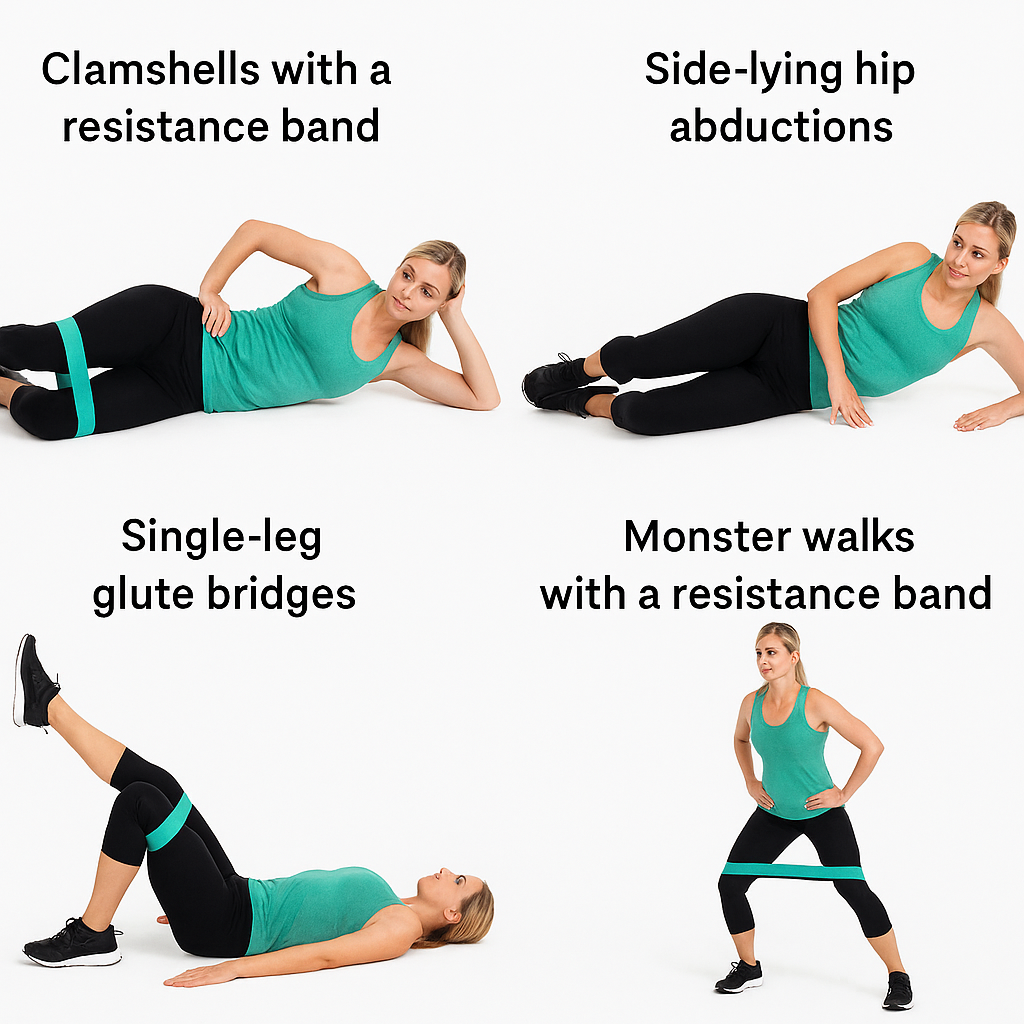
bridges, and monster walks with a resistance band
2. Stretch Smart
While stretching is helpful, focus more on strengthening. Gentle IT band stretches and foam rolling can help, but don’t overdo it. Listen to your body.
3. Check Your Shoes
Worn-out shoes can change your running mechanics. Replace them regularly and choose a pair that suits your foot type.
4. Mind Your Surfaces
Running on the same side of a cambered road? Switch it up! Flat, even surfaces are your friend.
5. Progress Gradually
Avoid sudden jumps in mileage or intensity. Build up slowly and let your body adapt.
Uh-Oh, ITBS Strikes! What Now?
If you’re reading this with a sore knee, don’t panic. Here’s what to do if ITBS hits:
Phase 1: Symptom Control (Week 1)
- Stop activities that make the pain worse.
- Apply ice after activity.
- Gentle stretching of the IT band.
- Start hip strengthening exercises.
- Try cross-training (like swimming or cycling) if it doesn’t hurt.
Phase 2: Strengthening Focus (Weeks 2-4)
- Progress your hip exercises (add resistance bands).
- Keep stretching and foam rolling (if comfortable).
- Focus on single-leg stability.
Phase 3: Functional Return (Weeks 4-8)
- Add lateral movements and plyometrics.
- Gradually return to running—start with short, easy runs.
- Consider a gait analysis to correct any issues.
Remember, everyone heals at their own pace. Be patient and celebrate every small win!
Returning to Running: Your Comeback Plan
Now, let’s talk about getting back to what you love—running! Here’s how to return safely:
- Start with walk-run intervals. For example, run for 1 minute, walk for 2 minutes, repeat for 20 minutes.
- Gradually increase the running intervals as you feel stronger.
- Keep up your hip strengthening and stretching routine.
- Listen to your body—if pain returns, take a step back.
- Celebrate your progress, no matter how small!
Transitioning back to running can be exciting. However, patience is key. You’ll be back at the start line before you know it!
| Principle | What to Do | Coach T’s Tip |
|---|---|---|
| Strengthen Hips | Clamshells, glute bridges, monster walks | Do these 3x a week for best results! |
| Stretch & Roll | Gentle IT band stretches, foam rolling | Don’t force it—listen to your body. |
| Check Shoes | Replace worn shoes, choose the right fit | Track your mileage and swap shoes regularly. |
| Surface Matters | Run on flat, even ground | Mix up your routes to avoid overuse. |
| Gradual Progression | Increase mileage slowly | Follow the 10% rule—no big leaps! |
Why Work with Coach T?
You might be thinking, “Can I really do this alone?” Of course, you can! But having a coach makes the journey easier, more fun, and way more effective. As Coach T, I’ve helped countless runners overcome ITBS and smash their goals. My coaching is personalised, supportive, and always focused on keeping you running happy.
Want to take your running to the next level? Book a call with me now and get two months of free coaching! Let’s work together to keep you injury-free and loving every step.
🏃♂️ Get Your Free PlanFinal Thoughts
IT Band Syndrome doesn’t have to sideline your running dreams. With the right prevention, smart management, and a safe return plan, you’ll be back on the road in no time. Remember, running should be fun! If you ever need guidance, support, or just a running buddy, Coach T is here for you.
Keep running, keep smiling, and let’s beat ITBS together!
👉 Meet your running coach (me!)
https://runningfitness365.com/our-running-coach/
👉 Book your call now and get TWO MONTHS FREE coaching
https://runningfitness365.com/tazi-running-coach/

Specific Marathon Training: Turn Science into Results
Plateauing in your training? Get a personalized plan to recover faster, race stronger, and enjoy every run.
- 🏃 Improve endurance and speed
- 💪 Reduce injury risk
- 🎯 Achieve personal bests
– Coach T 🟣💥🏃♂️
**Please note that the information shared in this article reflects my personal knowledge and experiences. It is not intended as professional advice and should not be relied upon as such. Always consult with a qualified expert or professional before making any decisions based on the content provided.