


A good marathon training plan does three things: it builds your endurance gradually, it teaches your body to hold marathon pace when you are tired, and it leaves you fresh enough on race day to use the fitness you built. Most plans that fail do not fail because the sessions were wrong. They fail because the runner ran the easy days too fast, skipped the recovery, or could not adjust when life got in the way. This guide explains how a marathon block is built, how to choose between 12 and 16 weeks, and how to get the full week-by-week plan built around your own pace.

Are you ready for a marathon training plan?
A marathon plan assumes a base. You should be running three to four times a week, be able to run for around 60 minutes without stopping, and ideally have raced a 10K or half marathon in the last few months. If you are not there yet, start with the free Couch to 10K plan or read how to start running safely, then move up to the free half marathon training plan. A marathon is far easier to train for when the shorter distances are already behind you.
12 weeks or 16 weeks?
Both lengths work. The difference is how much time you have to build.
- 16 weeks: the safer choice for most runners. The first block is strength and fitness work, then a test to set your marathon pace, then the marathon-specific weeks. You arrive at the hard training fresh and with a clear pace target.
- 12 weeks: for runners who are already fit, already running four or five days a week, and short on time. You get to marathon-specific work sooner, so there is less room for missed weeks.
If you have the choice, take the longer block. A missed week in a 16-week plan is a small adjustment. In a 12-week plan it is a real problem.
The weekly structure of a marathon plan
Almost every effective marathon plan follows the same shape each week, whatever the distance or the level of the runner:
- Easy runs. Most of your running, done at a pace where you could hold a full conversation.
- One midweek quality session. Threshold or 10-mile effort work, not all-out track repeats. It improves your running economy without wrecking the weekend.
- One long run. The spine of the plan. It starts as a simple steady run and gradually picks up marathon-pace work.
- Short strides or hill sprints. Brief, relaxed efforts that keep your legs springy and your form efficient.
- Strength and rest. One or two short strength sessions, and at least one full rest day.
Keep at least two easy days between your midweek session and your long run. Hard days only work when the days around them are genuinely easy.
Easy means easy
The most common marathon training mistake is running easy days too fast. Easy runs build your aerobic engine and let you recover from the hard days. If you cannot talk in full sentences, you are running a moderate effort that is too hard to recover from and too easy to improve you. Most easy runs do not need to go beyond about 65 minutes, and you do not need a heart rate monitor to get this right. The talk test is enough. If you want the reasoning behind this approach, read the 2 golden rules of marathon training and Coach T’s running philosophy.
The long run: the part that wins the marathon
Your long run is where a marathon is actually built. It starts as a steady run at a comfortable effort, then gradually includes blocks at marathon pace, and in the later weeks becomes a long run with most of the distance at marathon pace. Two things surprise most runners. First, you do not need to run 35 km or more in training; most runners peak around 29 to 32 km. Second, the final long run before race day is short and sharp, often around 16 km with most of it at marathon pace, because you want to arrive at the start line fresh, not tired.
How to set your marathon pace
Marathon pace is roughly 12 to 13 seconds per kilometre slower than your half marathon race pace. If you have a recent half marathon or 10-mile result, use it. Our marathon pace planner, running pace calculator and pace percentage calculator will give you your training paces in seconds. If you cannot hold marathon pace on a long run, run it 10 seconds per km slower. It still works, and it is better than burning out.
Taper and race week
The taper is where the training turns into fitness. In the last two to three weeks, reduce the volume but keep a little sharpness: one short session at marathon pace, easy runs that stay easy, and a short shake-out the day before the race. Do not try to squeeze in extra fitness in race week. It will not help, and it can only cost you. Practice your fuelling in your long runs, decide your race-day shoes early (our guide to the best marathon shoes for your running style can help), and plan your pacing before the gun goes off.
Common marathon training mistakes
- Running easy days too fast and arriving at the hard sessions already tired.
- Treating every long run as a race rather than a training stimulus.
- Adding mileage too quickly, which is how most marathon buildups end in injury. If something nags, see our guides on glute pain after running and hamstring strain recovery early.
- Doing too much speed work. Marathon fitness comes from sustained aerobic work, not from lots of intervals; see interval training for beginners for the right dose.
- Following a plan that cannot adapt when you get ill, injured or busy. This is where a coach makes the biggest difference. See is an online running coach worth it? and running coaching for runners over 40 and 50.
Want the full week-by-week marathon plan?
You will notice this guide explains how a marathon plan is built, but it does not give you every session of every week. That is deliberate. A marathon plan is only as good as its fit with your own pace, running history and weekly schedule, and a PDF that treats every runner the same is exactly what causes most training problems.
Coach Tazi shares the complete 12-week and 16-week marathon plans in two ways: on a free 20-minute call, where you talk through your goal and your week, or as part of 1-on-1 online marathon coaching, where the plan is adjusted weekly around how your training is actually going.
Training for a marathon? Tell Coach Tazi your goal and race date, and he will personally get back to you.
Not ready for the marathon yet? Start here
If a marathon is still a few months away, the free 12-week plans are a good place to start. Enter your email and Coach Tazi will send both straight to your inbox.
Free plan vs. 1-on-1 coaching
- Free plans and guides: a fixed structure that is the same for every runner, with no feedback and no adjustments once you start.
- 1-on-1 coaching with Coach Tazi: a plan built around your fitness, pace and race date, with weekly adjustments, direct messaging, and race-day pacing, fuelling and taper guidance. Coach Tazi is more than the person who writes your plan: he listens, and he adjusts your training around your work, family and life. Coaching runs €79 a month or €599 a year (less than €50 a month), can be paused for injury or travel, and starts with a free first month. See the coaching packages, or read how much an online running coach costs.
What Runners Are Saying

Anna
“I started with zero running experience. Zero confidence. Zero strength.
With Tassos’ coaching, everything changed. Step by step, smart training, strength work, balance and injury prevention built me up from nothing.
The result? I didn’t just finish one… I completed two consecutive Athens Authentic Marathons — healthy, strong, and smiling at the finish line.
The second marathon? We decided just 3 months before race day — and still nailed it.
No injuries. No burnout. Just smart preparation and belief.”
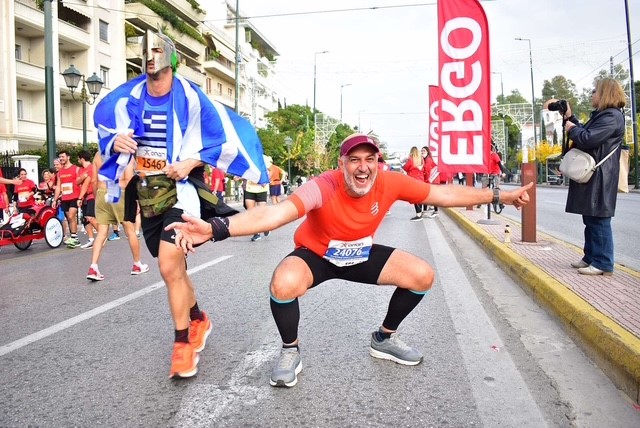
Demetris
“From plateau to breakthrough — exactly what I needed.”
Coach T isn’t just a running coach. He invests time. Real time. Checks in. Adjusts. Cares.
One year ago, I was completely stuck — no progress, just plateau. Through smart, structured training and constant guidance, everything changed.
Step by step, I became stronger, more consistent, and confident — leading to a new Marathon PB at Paris Marathon 2026.
Healthy. Strong. Injury-free.
Frequently asked questions
How long does it take to train for a marathon? Most healthy runners need 12 to 16 weeks of focused training, and that assumes you already run three to four times a week and can comfortably run for about an hour. If you are starting from less than that, build an easy aerobic base first, then start the marathon block.
Is a 12-week or 16-week marathon training plan better? Choose 16 weeks if you have the time, because it gives you a gentler build and a proper test of your fitness before the marathon-specific phase. Choose 12 weeks if you are already fit and running regularly, or if you are short on time.
How many days a week should I run for a marathon? Four to five days a week suits most runners: easy runs, one midweek quality session and one long run. More days can help experienced runners, but only if the extra runs are truly easy.
How long should my longest run be? Most runners peak between 29 and 32 km. You do not need to run 35 km or more in training. The marathon-pace work inside your long runs matters more than the raw distance.
What pace should I run my marathon training at? Easy runs should be conversational. Marathon pace is roughly 12 to 13 seconds per km slower than your half marathon pace. Use a recent race result and the pace tools on this site to set it.
Can I get a marathon training plan from Coach Tazi? Yes. The full week-by-week plan is shared on a free 20-minute call or inside 1-on-1 coaching, because the right plan depends on your pace, history and weekly schedule.
How to get started
Use the structure above to start your marathon training, and set your paces with the marathon pace planner. When you are ready for the full plan, built around you, book a free call with Coach Tazi, or learn more about your coach. You can also browse all of our marathon articles.
Ready to stop guessing? Book a free call and Coach Tazi will help you build your marathon plan.
Keep reading
- Zone 2 Running for Marathon Training: The Complete Guide
- Race Day Ready: Tempo Training for a Strong Marathon Finish
- The #1 Mistake Runners Make With Long Runs
- Marathon Training: The Science and Art of Running 26.2 Miles
**Please note that the information shared in this article reflects my personal knowledge and experiences. It is not intended as professional advice and should not be relied upon as such. Always consult with a qualified expert or professional before making any decisions based on the content provided